Pit & Seed · Gurez, Indian-administered Kashmir / Bandipora / Gurez
The Seed She Will Not Waste
In Chorwan, Gurez, farmer Hajra Begum still sorts potatoes for a straw-lined underground khraw — food for winter, seed for spring — while roads, migration, and drying springs leave fewer families keeping the pits alive.
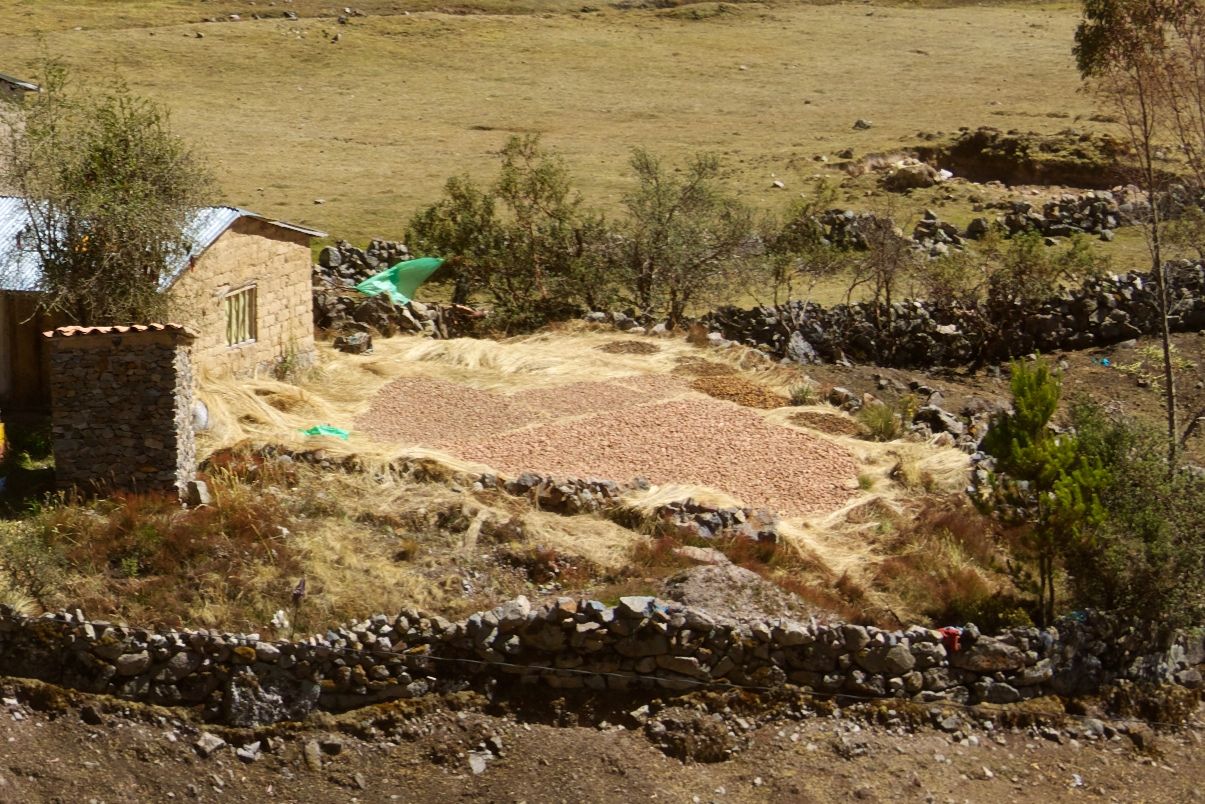
Illustrative / schematic only — high-altitude potatoes laid out for freeze-drying on the Lares Trek, Peru (Wikimedia Commons / McKay Savage). NOT a photograph of Hajra Begum; NOT Chorwan; NOT a Gurez khraw; not from The Guardian. Used to suggest seed-and-storage labour around potatoes, not the subject’s location.
What the hand sorts
CHORWAN, GUREZ, INDIAN-ADMINISTERED KASHMIR · NOVEMBER 2026
Hajra Begum rolls a potato in her hands, checking for cuts, soft spots, and rot. After harvesting in her family’s field in Chorwan — a mountain village in Gurez, Indian-administered Kashmir — she sorts the crop for winter: some potatoes to eat through the cold months, others to plant in spring.
These details were reported by Ishtayaq Rasool for The Guardian from Gurez on 3–4 November 2026. This Field Note is a secondary editorial account of that reporting — not an original interview.
A pit lined with straw
Begum, 40, is preparing to lower them into a khraw: an underground pit lined with straw and sealed against cold. For generations, khraws have kept potatoes, turnips, and cabbages through Himalayan winters, when snow cuts villages off from the Kashmir valley and temperatures fall below −20°C. Gurez sits about eighty miles from Srinagar, near the Line of Control; Razdan Pass, its main road link at roughly 3,600 metres, closes in winter.
The practice is thinning. Roads improved; young people left for work and school; fewer families keep the pits. Their decline threatens not only storage but local potato varieties — and the knowledge of which ones store well, resist rot, and yield a reliable harvest.
If you keep a bad potato, you will waste the whole next year.
What leaves with the pits
“When I was young, almost every family had three or four pits,” Begum told Rasool. “Now, down in the main valley, they have abandoned the practice altogether. Only a handful of families still use them.” She learned from her mother how to tell seed potatoes from those that rot or sprout too quickly. She is teaching her daughter, unsure the skill will last another generation.
Potatoes cover about forty-five percent of Gurez’s cultivated area, per a 2019 ICAR-NBPGR study, yet the valley’s genetic diversity is largely undocumented. Dr Sheikh M. Sultan of the bureau’s Srinagar station told The Guardian that varieties he once surveyed later became hard to find. Farmer Abdul Jabbar Mapnoo, 70, of Chorwan, remembers winters of six feet of snow and two or three khraws per house; he says springs are drying and potato yields have fallen. Drier springs and thinner snow push households toward market and subsidised supplies.
What remains open
Rasool’s November 2026 reporting settles the sorting, the thinning pits, and the undocumented varieties. It does not settle whether Chorwan’s remaining khraws outlast the next generation, who records the seed before it leaves cultivation, or what a cut-off valley eats when the underground stores empty first.
Sources & Reading
Ishtayaq Rasool, “Kashmir’s potato pits are vanishing – and generations of knowledge could be buried for ever,” The Guardian, 3–4 November 2026. — Primary reporting: Hajra Begum (Chorwan, Gurez); khraw practice; thinning pits; daughter skill transfer; ICAR-NBPGR / Dr Sheikh M. Sultan; Abdul Jabbar Mapnoo on snow and drying springs; Ateeqa Begum sorting; Kishanganga land pressure on Badwan.
Related Forces
Related Places