Counted Water · Kabale, Southern Uganda
The Water Her Mother Could Not Count On
In Kabale, southern Uganda, water engineer Kyokushaba Shine, 31, builds solar pumps and drip irrigation for smallholders after watching her mother’s onion harvests fail for lack of water — a company started in February 2025 with neither staff nor capital that has, she says, installed 30 systems in just over a year.
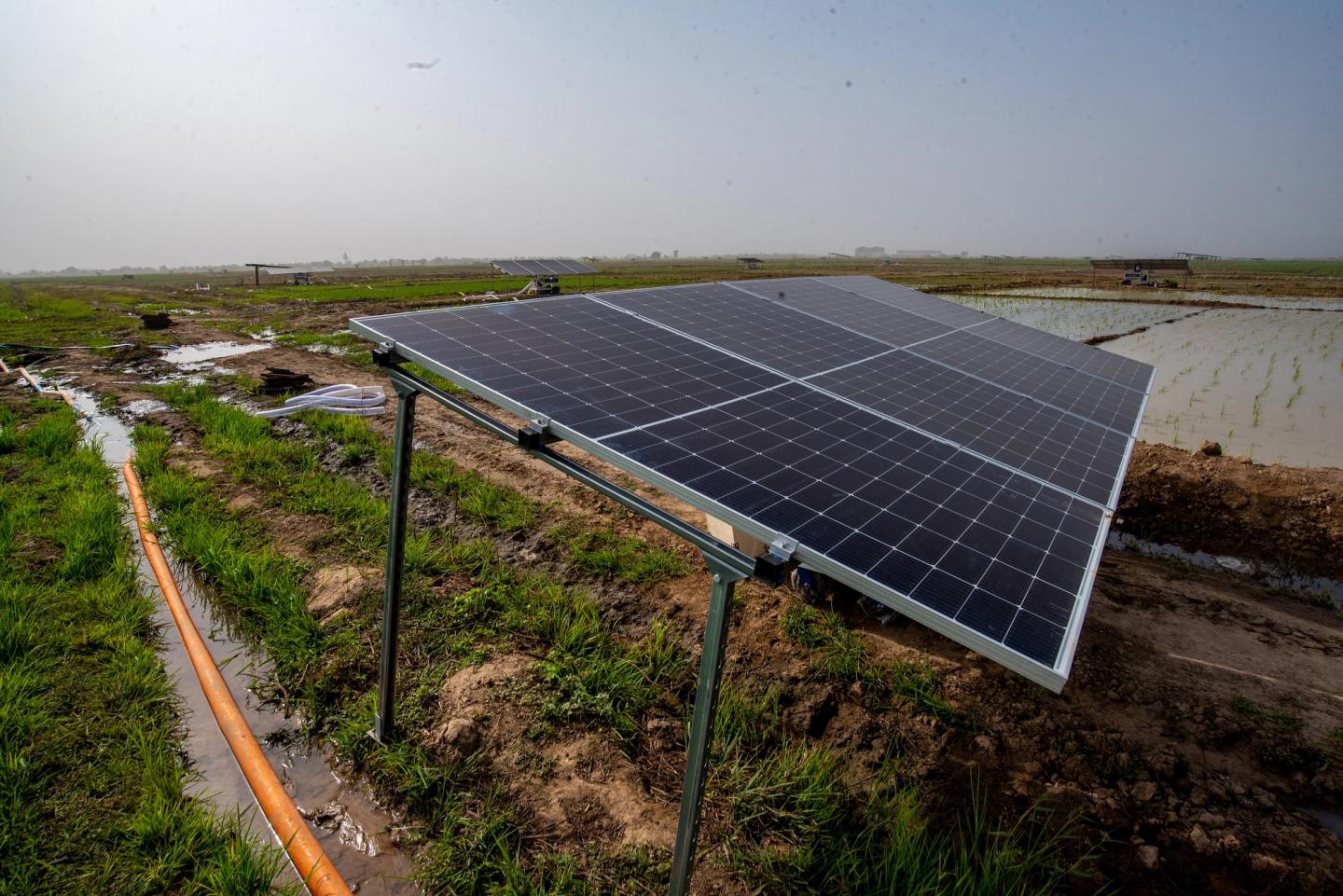
Illustrative / schematic only — solar panels used for irrigation on a rice farm in Nigeria (Wikimedia Commons / SMMIMAGES, Wiki Loves Africa 2025). NOT a photograph of Kyokushaba Shine, her company Winta Engineering Solutions, or any system installed in Uganda; not from The Guardian. Used to suggest the kind of solar-powered irrigation described in the reporting, not the Field Note subject.
What she watched before dawn
KABALE, UGANDA · NOVEMBER 2026
As a little girl in Kabale, southern Uganda, Kyokushaba Shine watched her mother rise before dawn to tend onion acres near their house. The harvests were the family’s only income. They often failed. A lack of water, or soil already degraded, could leave almost no yield, and not enough food on the table.
These details were reported by Stefanie Glinski for The Guardian on 2 November 2026, in a dispatch also bylined by Valentine Benjamin, Sarah Johnson and Kenneth Zindondo. This Field Note is a secondary editorial account of that reporting — not an original interview.
I started my company with the goal of designing small and affordable irrigation systems for smallholder farmers. When I started the business in February 2025, I had neither staff nor capital, but I had a goal in mind and I wanted to work towards it.
What one year of systems has reached
Now 31, a water engineer and entrepreneur, Kyokushaba has made it her mission to help farmers like her mother. Winta Engineering Solutions designs and installs mostly solar-powered pumps, paired with drip irrigation. The company digs boreholes where needed and trains farmers to run and maintain the systems.
In just over a year, she said, Winta has installed 30 water systems across Uganda, most of them solar-powered, and more than ten for female farmers. About 80 percent of her team are women. She has begun connecting farmers with local microfinance lenders, who offer loans of about five million Ugandan shillings (about £1,000), usually repayable in two years.
What water alone cannot restore
Reliable water is not the whole problem. She also runs educational programmes on how the climate crisis and soil degradation affect a farmer’s ability to grow food.
Farmers want results fast, so they use fertilisers to increase their yields quickly, but sometimes that means they don’t protect the health of their soil. It’s not enough to have sufficient water if the soil is degraded, and that’s why we have started working on awareness campaigns.
She told Glinski that creating opportunities for women still matters in a sector largely dominated by men. She has a five-year-old daughter; it is just the two of them. She wants that daughter to know that women and girls are strong.
What remains open
Glinski’s 2 November 2026 reporting settles the remembered onion acres, the February 2025 start without staff or capital, Kyokushaba’s account of 30 systems, a mostly female team, the loan size, and her warning that water is not enough if the soil is spent. It does not settle how many of those systems will keep running, whether soil campaigns can catch a fertiliser rush, how far beyond “more than ten” female farmers the work will reach, or what kind of sector her daughter will walk into.
Sources & Reading
Valentine Benjamin, Stefanie Glinski, Sarah Johnson and Kenneth Zindondo, “They assume the man next to me is the owner”: four women doing business in Africa in their own way, The Guardian, 2 November 2026 (first published 2 November 2026, 05.00 EST). — Primary reporting (Stefanie Glinski’s Uganda section): Kyokushaba Shine, also captioned Shine Kyokushaba, 31, water engineer and entrepreneur, Kabale, southern Uganda; as a child watched mother rise before dawn to tend onion acres near the house; harvests were the family’s only income and often failed from lack of water or degraded soil, leaving almost no yield and not enough food; founded Winta Engineering Solutions in February 2025 with neither staff nor capital, aiming to design small affordable irrigation for smallholders; in just over a year installed 30 water systems across Uganda, most solar-powered, more than 10 for female farmers; team about 80% women; designs/installs solar pumps plus drip irrigation, digs boreholes where needed, trains farmers to operate and maintain systems; collaborates with local microfinance providers offering loans of about 5m Ugandan shillings (about £1,000), usually repayable in two years; runs educational programmes on climate crisis and soil degradation; quote on fertiliser rush vs soil health and awareness campaigns; creating opportunities for women in a male-dominated sector; five-year-old daughter, “just me and her”; wants her to know women and girls are strong. Article title quote is from another profiled entrepreneur (Ifedolapo Runsewe, Nigeria), not Shine. Guardian report photographs were not reused.
Related Forces
Related Places